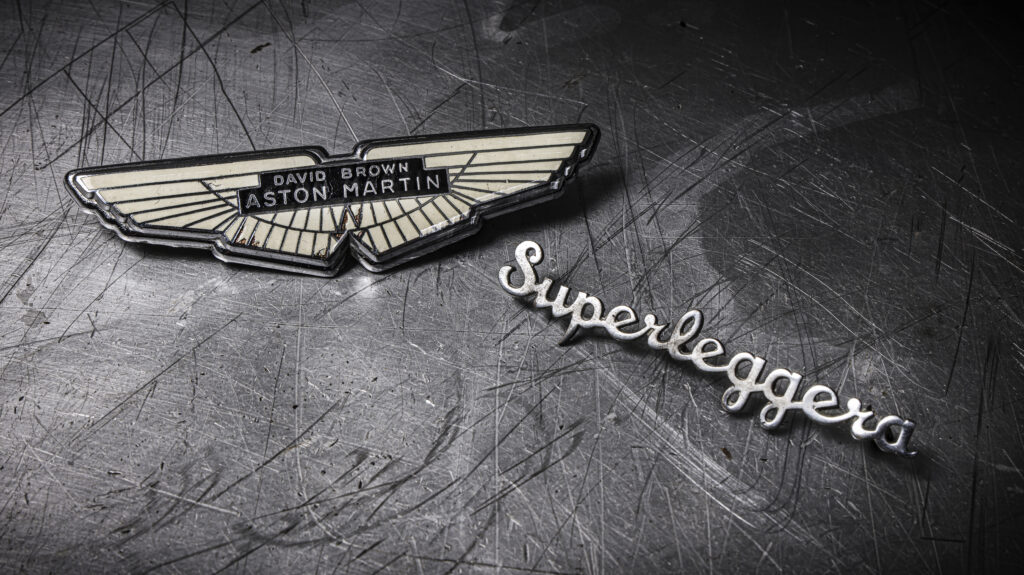
It’s possible to start out as a kid, tinkering with Japanese trail bikes in your garage in England, and later become an expert restorer of the most valuable and most iconic Aston Martins, in France. It happened to Bob Slack, who now works his magic at the BPM Group’s Aston Martin dealership in Bordeaux.
If you’re looking for the soul of Aston Martin, you might just find it here, in Bob Slack’s workshop. Here sit an incomplete DB6 Vantage and a DB2/4 Mk III, amidst sundry parts bearing the winged logo, scattered but carefully arranged. But even without them, you would sense the essence of Aston Martin in the atmosphere that’s both serious and serene, respectful and affectionate. There’s something in the air that radiates pure passion, a love for meticulously executed work, carefully crafted metal and mechanical arts elevated to the highest degree of exclusivity and perfection.
It is here, at the Aston Martin dealership in Bordeaux, that Heritage Manager Robert Slack – Bob to his friends and clients – carries out his makeovers and brings back to life the cars entrusted to him by customers. Customers who, very soon after they arrive, become more than that: they become friends and admirers of the English magician. As he explains, it’s no surprise, since they’re often as fanatical about the brand as he is.
Was he predestined to become a miracle worker? “I fell in love with Aston-Martins very early on, more than 50 years ago, in the 70s.” But Bob followed a somewhat unusual course. “Strictly speaking, I didn’t study mechanics: I learned everything on the job, by myself.” He started young. “From the age of 10, I was tinkering with motorbikes. I loved Japanese bikes, they were like a drug to me.” A hard and highly addictive drug. Motorcycles soon covered every inch of his garage. “At one point, I had 19 of them! No road bikes, I was more attracted to trail bikes like the XT500. I fitted them with exhausts without silencers.” For the sound and the thrill, obviously.
His love for Aston Martins took root even earlier. “When I was a kid, my uncle owned several. His collection included a pre-war Ulster, a DB4 and a DB6.”
I was very young at the time, but I still have a very clear memory of the distinctive and haunting sound of the exhaust from my uncle’s Aston Martins.
Surrounded by extraordinary cars, he lives a waking dream. “I was 16 and yes, it was like a dream. I worked 7 days a week, often to 9 in the evening, just for the pure joy of it.” First in England, then in France, with Alain Aziza, who brought him to Paris. But the Parisian life didn’t suit him, and after four years Bob returned to England. He worked for several different garages – all Aston Martin, of course – and then, in 2014, Alain Aziza called him back. He had just acquired several collectible Aston Martins, and wanted them to be restored by the person he trusted most: Bob. And as he would be based not in Paris but at the Auto-Performance dealership in Bordeaux, Bob happily packed his bags and crossed back over the Channel.
This time, he says, he’s here to stay. He likes the region, and he loves the job. “Restoring an Aston Martin is both very demanding and hugely exciting.
An Aston Martin has some very specific characteristics, visible as well as invisible – engine, chassis, transmission.
That’s why, when you’re restoring an Aston Martin, you can’t just make it up as you go along. It takes considerable experience navigating all of its charms and secrets before you can even get started. “It’s understood in the industry that it takes a minimum of 10 years’ apprenticeship to acquire the know-how necessary to restore an Aston Martin.” And Bob already had much more than that. Upon his return to France, he restored six cars. From top to bottom. He truly is a master magician, holder of arcane knowledge and unique expertise.
It’s well-known that the more you learn, the more you want to learn. Bob’s fascination with Aston Martin is undiminished and continues to grow, and the human aspect of his work provides him with an additional source of pride and pleasure. Aston Martin Bordeaux belongs to the BPM Group (Bornhauser Performance Motors), and they share the same values.
The fact that Bob’s love for the brand is shared at the highest level of the group makes a real difference. Bob recalls Patrick Bornhauser’s enthusiasm for the brand: “He competed in the Le Mans 24-Hour Race with a DBR9, which he still owns.” Obviously, Bob feels in tune.
For him, Aston Martins stand out from all other sports cars, including other English brands.
“An Aston Martin is a GT of unrivaled distinction. It has that aura of exclusivity that transcends its Britishness.”
“Whether in terms of its body design, its interior or its engine sound, an Aston Martin is in a class of its own.” Sporty, but with a subtle touch of refinement that makes it truly unique.
And that is why Bob, the Aston Martin magician who brings legendary cars back to life, continues to weave his spells.
P.S. If you dream of owning an Aston Martin DB6 Vantage, you’ll be interested to learn that the superb black car featured in these photos – a Bob Slack restoration – is for sale!
Why create a very exclusive watch in homage to Mike Hailwood for the Pecqueur Motorists Club? Read the incredible story of the day when, 11 years after his retirement as the greatest motorcycle champion of all time, Mike Hailwood returned to competition, on the most dangerous race in the world.
Mike Hailwood had everything to lose: the race, his honour, his pride, the money – perhaps even his life. On that day in June 1978 when he showed up for the start of the Formula One race, the flagship event of the TT Races, with his Ducati 900SS, he was full of doubt. Was it the right decision? Or had he made a terrible mistake by coming today?
Obviously, he was there to win – as he always had been. Twelve times previously, he had triumphed in the Tourist Trophy on the hair-raising roads of the Isle of Man, nestled between the UK and Ireland in the Irish Sea. But the British rider, with nine World Championship titles to his name, had retired from motorcycle racing in 1967, 11 years earlier.
Mike Hailwood on 4 wheels, pictured here in 1970 with the Formula 5000 Lola T190.
Since then, he had devoted himself to car racing: Formula 2 European Champion in 1972, podium places and victory in Endurance, and 50 Formula 1 competitions between 1963 and the day in 1974 when, in the green hell of the Nürburgring’s Nordschleife and the forests of the Eifel, a serious accident put what he thought would be a definitive end to his racing career. His right leg was badly broken, leaving him with an ankle injury from which he never fully recovered. He left the automobile racing world without any great regrets. In any case, he preferred the world of motorcycles, which he felt was more fun, more spontaneous, more exciting. Car racing, and Formula 1 in particular, were too calculating, too serious. Although Mike Hailwood was a hard worker, what he really wanted was to have fun.
Bare heads and fun with friends, Mike Hailwood and James Hunt at Brands Hatch in 1964.
And in motorcycling he had a lot of fun, for a solid decade between 1957 and 1967. He won everything, in every category, with humility and infectious enthusiasm. He managed to win virtually every event he started, despite never having the very best equipment on the field. It was the man, not the machine, that made the difference. But all that was before – over a decade before the 1978 TT Race.
The sunny smile and enthusiasm of youth. Mike at Oulton Park in February 1967.
Mike Hailwood no longer cut quite the same dashing figure as he had in his glory years, when he was sharp as a Sheffield blade, slender, lively and effortlessly elegant. His flirtatious smile and teasing demeanour were a magnet to women, and he played the role of playboy with boyish enthusiasm. After retiring to New Zealand, Mike had filled out a little. Anyone who hadn’t seen him on a motorcycle circuit for 11 years might have had trouble recognising him, with his receding hairline compensated by locks halfway down his neck. And then there was the visible discomfort when he walked. Mike was 38 years old. Not old for ordinary mortals, but that was the point: if, in his first life as a biker, Mike was neither ordinary nor, it seems, mortal, what was he like now?
An insane race
Now, he was feeling the hopes and fears of all his fans. The Isle of Man TT Race, created in 1907, is probably the world’s most exciting motorcycle race, and certainly the most dangerous (267 motorcyclists have lost their lives over the course of 102 events). At the end of the 1970s, in the TT Formula One, the six laps of the 60 km course, with its 264 turns – 360 km and 1584 turns in total! – were completed at an average speed of over 170 km/h. Constant concentration required. Granted, the protective equipment was a little more effective than when he had last raced there: the suits were slightly thicker, and the goggles and bowl helmet combo had been replaced by full-face helmets.
Mike at the 1958 TT Races. Lift-off at Ballaugh Bridge
But the Tourist Trophy takes place on a natural circuit: country roads and village streets, with their inevitable kerbs, telephone booths, trees, stone walls and unforgiving house corners, all navigated with the throttle grip stuck open to the max. Everything is raw, sharp, threatening, deadly. Drivers hit top speeds of 230 km/h as they pass into the shadows thrown by sinister tree trunks, blinding sunlight strobing through the leaves. In places, the bike is airborne – at Ballaugh Bridge, for instance, where touchdown is followed by an immediate right turn between the houses of the village. It’s a biker thing. As Giacomo Agostini said, here you must forget about danger and death. In fact, it’s so dangerous that in 1976 the TT was withdrawn from the World Motorcycle Speed Championship, which now features closed circuits only. But the most insane circuit of them all continues to attract the most insane riders.
Believe in miracles
Crowds pack the roadsides, here to see Mike the Bike. For the British, he’s a local hero. For the rest of the world, he’s a legend. Here on the Isle of Man, Mike is on home turf, but he’s also a global superstar. In addition to his victories on the island, he has also racked up 76 Grand Prix wins for 152 starts, an incredible record of 50% of races won, 112 podiums, 79 pole positions and 105 lap records! His nickname, “Mike the Bike”, is not just a lucky alliteration – it’s a statement of fact. Never has there been such symbiosis between a man and his machine. Mike represents the essence of motorcycle racing, the highest expression of balance, finesse and precision (“on a motorcycle, I never slip!”), aggression, pugnacity, audacity and courage.
At home with the elder Mrs Hailwood. Mike was only 19 years old in 1959 but his trophy shelves were already full to bursting.
White Martini bucket hats bearing his nickname in red letters abound. Everyone is rooting for him to win. Obviously, nothing could be less likely; it would be a miracle, but we all like to believe in miracles. Just this once. As in previous editions, and like many other drivers, Mike has entered several other categories besides Formula One: Senior, Junior and Classic TT. The results aren’t great. On his Yamahas, he finishes 28th and 12th. But the Formula One is the race to win – on his Ducati.
All Mike knows is that he has prepared carefully. He’s done all he can. However, as he revealed in an interview, “I felt the island would continue to be kind to me”. He knows that, if he had to force himself to race a whole Grand Prix season, he would have no chance. But this race is unique. So he purchased his 900SS from the Ducati shop in Manchester, had it prepared in England, with a little help from the factory (Italian pragmatism – they weren’t convinced his comeback would be successful, but you never know…), and embarked upon some serious testing. “We did tests on loads of tracks all over England, for days and days and days. But of course, riding on small circuits is not quite the same as riding on the Isle of Man.”
The bike was hard to handle, but Mike had carefully prepared his Ducati 900SS.
Mike knows every one of the route’s twists and turns by heart. He’s figured out what to do. The 88 hp Ducati engine? Generous: you need maximum torque and power to deploy on the widest possible range of revs to ease up the ride. The chassis? Lighter and, to accommodate the new slicks supplied by Dunlop, slightly wider at the rear end. But the main tweak: to avoid being handicapped by a right ankle which no longer has the power, endurance or agility of yesteryear, the gear change is installed on the left side. And it seems to be working. In the Formula One tests, Mike smashes his own record from 1967, set at an average of 172 km/h aboard a 500 cc Honda. The 178.6 km/h record he set in 1978 makes people dare to believe he could do something amazing in this race, with his red and green machine stamped with the number 12.
In the name of the father
Legend has it that between 1967 and 1978 Mike never once got behind the handlebars of a motorcycle in competition. That’s not strictly true. To assess his level, he took part in a few races, notably in Australia, before returning to the Isle of Man. But that’s not the point of this story.
For Mike, another momentous event marked the start of the year: less than three months before the Tourist Trophy his father Stan died at the age of 75. Stan was a huge part of Mike’s life and career. A millionaire who had made a fortune in a variety of businesses, including motorbike sales, he devoted his life to ensuring his son had everything he needed to race under the best possible conditions. In fact, his nickname was “The Wallet”, suggesting that Mike owed his career to his father’s deep pockets. But Stan insisted that every penny he invested in his son’s motorcycles and career had to be profitable.
Fortunately, Stan was standing by to help Mike carry two more modest trophies, for the 125cc and 250cc categories at the 1961 TT Races.
Mike never rejected his father’s help, or kept it secret. He made the most of it, while at the same time building a reputation on the track through his talent, his hard work and the empathy he showed in his relationships with fans and fellow competitors.
In photos from his racing years, between 1957 and 1967, we often see Stan standing near his son before or after the race: well-tailored suit, carefully clipped white moustache, hat “as big as a sombrero” (according to one particularly hyperbolic report from the time).
Another hat falls victim to paternal pride as Mike crosses the finish line to win the 1961 TT!
Now, Mike had to stand alone, without the support of his father, his benefactor and mentor. Stan would no longer be there at the finish line, waiting to tap his son on the shoulder and give him a well-earned hug.
Now, on the starting line, Mike thoughtfully contemplates the crowd and tells himself he has no right to disappoint these people who had come to cheer him on, just like his father used to.
Comeback king
Mike Hailwood and Phil Read in June 1978.
And then they’re off. Sixty-three competitors set off in the TT Formula One category. Mike’s biggest rival is Phil Read, “the Prince of Speed”, with seven world championship titles and 8 TT victories to his credit. A handsome, lively chap with a full head of hair, Phil is a year and three months older than Mike, but he looks younger. He’s determined to make the returning retiree eat his dust. Phil had never stopped racing, in fact he won the Senior and Formula One categories the previous year. He wasn’t going to let that old has-been show him up.
A blast from the past: Mike setting off on his MV Agusta in the 60s. He remains in side-saddle position until he’s sure the bike has built up enough speed.
The last time Mike raced the TT, riders had started two at a time, pushing their motorcycles off and perching side-saddle, before mounting like jockeys once they had picked up some speed. Now, the racers still started in pairs, but they rode off from the starting line. Mike started 50 seconds after Phil Read and his Honda four. Immediately, Mike was literally flying down the road in his signature no-nonsense style. At the end of the first lap he was already leading the race, 9 seconds (corrected time) ahead of his closest pursuer, and 20 seconds faster than Phil Read. On the third of six laps, Mike overtook Read on the road and started to build a comfortable lead. On the 5th lap, Read was forced to come to terms with his humiliation: visibly outclassed, pushed to his limit, he dropped out of the race after his engine finally gave up the ghost.
By the third lap, Mike has gained 50 seconds and overtaken Phil Read, who from that point on will see only his rear wheel, his back, and then no Mike at all.
Hailwood breezes over the finish line, intoxicated by the delirious cries of the crowd. The spectators gesticulate frantically as he passes, waving their programmes in the air, screaming so loudly that he can even hear them under his helmet in the slower sections of the track: “Crazy! I’ve never seen anything like it!” he comments after the finish.
The podium of the 1978 TT: Mike Hailwood stands between John Williams and Ian Richards
On the podium, Mike waves his yellow Dunlop cap and treats himself to a long swig of champagne straight from the jeroboam. John Williams, red bucket hat screwed on his head, who came second on his Honda, hands him the bottle, content to have been beaten by the greatest of them all. He takes a pull on the cigarette he holds between thumb and index finger, then applauds the champion. The ceremony is less solemn than it is today, but it’s sincere, a mark of honest admiration. Mike squeezes out a furtive tear. His father is not in the crowd to cheer him on, but he savours the moment anyway. He has proved that, at the age of 38, he’s still got what it takes.
The legend
This was Mike Hailwood’s 13th victory in the Isle of Man TT Race, the world’s craziest motorbike race. This was the win that elevated him to the rank of absolute legend. He’d come back from nowhere, after 10 years, immediately reclaiming his position in the top ranks of the sport. In fact, Mike won another TT race the following year, in the Senior category, riding a Suzuki RG500. Over the course of his career, he rode 70 different motorcycle models, from 50 to 1000 cc, from around 15 different brands, and he led almost all of them to victory. But if we were to single out just one machine from this incredible collection, it would be the Ducati 900SS from the 1978 TT Race. So let’s only remember the legend.
Even in full attack mode Mike Hailwood rode with astonishing fluidity, as if his victories were merely the conclusion of a gentle Sunday outing.
All this happened 46 years ago. And that’s why only 46 copies of the Club Pecqueur Motorists “Tribute to Mike the Bike” watch are being produced. It features subtle touches recalling the Italian livery of the Ducati 900SS, which was predominantly red with a green lower fairing, separated by a white trellis frame. Even the back of the watch, which will be worn next to the skin, holds some surprises: the case features a number “12” – the motorcycle’s race number – in authentic Ducati typography, while the reverse of the bracelet comes with stitching in a complementary colour, either red or green. This highly exclusive watch is as unique and as legendary as the man and the insane exploit it was designed to commemorate.
Marco Hug is Chief Designer for the independent watch design studio Neodesis, which was chosen by BPM to give each of the Club Pecqueur Motorists’ themed watch collections their own personality. Marco is also a motorcycle enthusiast. So he had a blast working on the “Tribute to Mike the Bike” watch.
Reading time: 4 minutes
A graduate of the La Chaux-de-Fonds School of Applied Arts in Switzerland, Marco Hug began his career at a jewellery workshop in Biel, where he also developed watch designs. After that he joined Louis Chevrolet Watches*, before moving to watch brand Parmigiani Fleurier a few years later as head of their design studio. He joined Neodesis three years ago.
Marco, what was your inspiration for creating the “Tribute to Mike the Bike” edition of the Club Pecqueur Motorists watch, which acts as the Club’s access code and emblem?
Marco Hug: I received a very comprehensive brief from Romain Guettal of Groupe BPM. Romain outlined for me the major stages of Mike Hailwood’s career, and explained the Club Pecqueur Motorists’ wish to reference and commemorate his historic win at the 1978 Isle of Man TT Races. I then looked for anchor points to highlight elements linked to the Ducati 900SS on which he rode to victory 46 years ago. One obvious link is that the collection comes in a limited edition of 46 numbered pieces.
Which elements caught your attention?
First of all, I focused on incorporating the three official colours of the Ducati racing team: red, green and white. I wanted a distinctive sign to appear on the time zone adjustment disc, so I decided to highlight the zero in green. This creates a subtle break while also enhancing readability, thanks to the contrasting midpoint. Then, in reference to the colours of the racing gauges, I chose white for the interior of the dials indicating local time and home time. I also added green or red for the seal around the crystal, and the same for the Saphyr back, through which the Pecqueur LTM 5021 movement can be seen. The perimeter of the small seconds subdial is accented with the three Ducati team colours. To stay consistent with the new black-on-white colouring of the hands, I also changed the colour of the moon disc indicating day and night from blue to black. And finally, for a more matte finish, the Geneva striping on the dial has been replaced by a satin finish with engraved lines.
Did you also work on the back of the watch?
Of course! On the Saphyr caseback I added the number 12, which was the number of the bike with which Mike Hailwood won the 1978 Tourist Trophy, in the distinctive typography of the Ducati brand.
Are there any other elements that differentiate this watch from other pieces in the Club Pecqueur Motorists collection?
Yes, the strap has a fairly unique feature. If the seal around the dial is red, the topstitching on the strap is also red, while the lining is green with red stitching. And vice versa: if the seal is green, the lining of the strap is red. I feel this approach gives an even more authentic and distinctive touch to this haute horlogerie timepiece.
Have you ever worked on a motorsports-themed project before?
No, this was my first time! But as a former biker, and an enthusiastic owner of a Yamaha FZR 750 Genesis and a Honda CBR 900, I loved every minute. And the Mike Hailwood connection really appealed to me. He left his mark on motorcycle racing through his technical mastery on the track, as well as his personality off the track, which was greatly appreciated by both fans and fellow racers. He was also one of the very few motorcycle racers to successfully cross over to motor racing, competing in Formula 1 for several years after his motorcycle grand prix victories. Working on this new watch collection, I also appreciated the link to Italy through Ducati. As a designer, I’m a huge admirer of Guigiaro, founder of Italdesign, who left his mark on a number of industrial fields, not just cars. Italian designers often have a very recognisable signature.
* Originally from the town of La Chaux-de-Fonds, Swiss racing driver Louis Chevrolet (1878-1941) emigrated to the United States and founded the Chevrolet automobile brand in 1911.
The Club Pecqueur Motorists is intended for enthusiasts of the Mechanical Arts in all their rich diversity. I assume you’re one of them – as I am myself! All my life, I’ve been fascinated by beautiful cars, powerful motorbikes, exceptional planes, mighty off-shore or vintage motorboats, haute horlogerie timepieces, and all the other mechanical marvels born of human ingenuity.
That’s what gave me the idea of founding a club for individuals looking to develop a stronger connection with the finest, most ambitious, most exclusive mechanical creations, to share their passion, and to meet the brilliant minds behind these inventions. My vision for the club involves offering exceptional events and experiences that align with the extraordinary breadth of our collective interests. That’s how the Club Pecqueur Motorists was born.
Why Pecqueur? In tribute to master watchmaker Onésiphore Pecqueur, born in 1792, who is considered the very first automobile engineer. In 1819 he invented a mechanical differential for lockworks of wall clocks and, in 1827, applied this innovation to the chassis of a steam-driven vehicle prototype. This adaptation of clockwork mechanics to an automotive context symbolised for me much of what I wanted to express through the Club: my instinct that the mechanical arts are all part of a mutually enriching ecosystem, which thrives on technological innovation – yes – but also on the deep emotional connections it fosters.
It was the perfect narrative. And so, I decided that membership of the Club Pecqueur Motorists would not be signified by a mundane plastic card, but by something far more exclusive – something that captures the essence of Pecqueur Motorists’ DNA. There would be no membership card as such. Instead, there is a watch – a unique timepiece, specially designed and produced in limited thematic series. Each numbered watch is identified with a single Club member.
…
Furthermore, to capture the essence of the Club, I wanted the watch to feature an exclusive GMT complication inspired by Onésiphore Pecqueur’s mechanical differential. Club members will bear it on their wrists as a marker of their interest, a subtle testament to their shared understanding and a symbol of pride in their membership. This unconventional approach reflects both my fascination with the mechanical arts and my goal of infusing the Club with unique and exclusive elements.
I do hope that we will welcome you soon into our fellowship of mechanical arts enthusiasts.
Patrick Bornhauser Founding President of BPM Group
It’s impossible not to fall in love. Everything about this boat oozes grace and beauty: proportions, materials, equipment. Every detail has been carefully calibrated to conjure up the legendary films that defined glamour for an entire generation.
The boat may scream la Dolce Vita, but the J Craft Torpedo in fact comes from Sweden. Its heritage is impressive: the J Craft workshops are in Gotland, Sweden’s largest island, right across from Latvia on the icy Baltic Sea. It’s said that the Vikings built their longboats there, and it remains the centre of Sweden’s naval construction industry today. J Craft, which has been in business since 1999, makes a point of honouring tradition, valuing craftsmanship and demanding excellence. All of these qualities can be found in their Torpedo, a superb 42-foot runabout (12.63 metres). Despite being a familiar sight in the balmy marinas of Monaco and Porto Cervo, these boats are designed to cope with the rigours of the high seas in the extreme north of the Baltic Sea.
Everything is made by hand and on request. When you choose a J Craft Torpedo, you’re not just choosing a boat. You’re expressing your love for the sea, a certain lifestyle, and fine craftsmanship. You can start with the online configurator (https://j-craftboats.com/configuration) and play around with the different hull colours, finishes and equipment. But to bring your dream to life, you’ll need to spend some time talking to J Craft’s designers before manufacturing can start.
J Craft and Club Pecqueur Motorists have plenty in common. Each Torpedo is absolutely unique, reflecting the wishes of a unique individual. Each Torpedo is individually built by a small team, which works on the boat from the very beginning to the day it’s launched, and beyond. It takes at least 8,000 hours to build each boat, and often more. The mahogany deck alone requires 18 coats of primers and varnish to create the perfect finish that will withstand time and the elements, without losing its old-time Hollywood glamour.
Beneath the timeless appearance of the classic runabout of the 50s and 60s lies high-performance technology. The J Craft Torpedo is powered by two latest-generation Volvo Penta IPS (Inboard Performance System) inline 6-cylinder engines. There are four types of powertrains to choose from, with individual displacement and power ranging from 3.7 to 6.7 litres and 400 to 650 horsepower.
Power is transmitted to two sets of forward-facing counter-rotating dual propellers, which pivot independently from one another to steer the boat. There’s no rudder: instead, the electronic steering is controlled by a joystick, allowing for highly precise manoeuvres, particularly when navigating in harbours, ensuring a majestic arrival accompanied by the subtle shimmer of mahogany, in perfect keeping with the Torpedo’s effortless styling.
Further advantages of this extremely compact powertrain include a maximum speed 20% higher than traditional systems, with fuel consumption that is 30% lower at cruising speed, and significantly reduced vibrations and noise levels, even with a full load. Equipped with the 650 RS engine, the J Craft Torpedo offers a cruising speed at medium load of 30 knots (~56 km/h), allowing for a range of around 280 nautical miles (520 km). With the throttle fully open, the wind in your hair and the sea spray in your eyes, you can rip through the waves at a speed of 47 knots (87 km/h).
The “Babebi” that turned heads at the Cannes and Monaco Boat Shows at the end of last year was the 21st Torpedo produced by J Craft. With a metallic-finish hull, brass interior and upholstery in yellow and cream with diamond stitching, the styling is bold, original and extremely refined. The boat can easily accommodate up to 10 people for a day cruise, and the luxurious cabin is equipped to allow four people to travel, live and sleep in comfort. Ultimate glamour on the high seas.
The origin of the Club Pecqueur Motorists lies in an innovative idea and a unique ambition: to create a platform that would bring together the different Mechanical Arts under a single concept, offering enthusiasts the opportunity to explore their passion, to experience it to the full and to meet other like-minded individuals. Another innovative idea was to give the Club its own original, tactile and mechanical emblem: a watch, produced in highly limited, themed Tribute collections. These are the first.
The idea of making a watch the membership card of the Club Pecqueur Motorists is in perfect coherence with the Club’s aim. A watch is a noble object of mechanical artistry, and a fitting symbol of Club membership for anyone with a passion for the mechanical arts. It’s an object that is worn next to the skin – not a plastic card to be kept in your wallet with all the others.
The pedigree of this watch places it in the category of Haute Horlogerie. Its GMT calibre is exclusive, and its design is unique. The result could not be more convincing, as confirmed in private consultation with some of Switzerland’s most prestigious watchmaking houses.
Finally, to complete the rich back story of this rather special timepiece, and to take the innovative concept to its ultimate conclusion, we have decided that there will be no “standard” version of this watch.
Instead, there will be a highly limited “First Edition” micro-series, which will be followed by a series of themed collections paying tribute to a specific man, brand or event that have made a mark on the mechanical arts.
The ambition and innovative heritage of the watch itself will be augmented by the tribute.
Given our emphasis on highly limited series, it’s clear that these watches could not be more different from those that are mass-produced for a global market, even when they bear a prestigious name.
Exclusivity is one of the primary values of the Club Pecqueur Motorists, and our horological access card makes this very clear: each watch is allocated individually to a specific club member. Club members are identified by their name and by the serial number of the watch they select to confirm their membership. The serial number also includes the reference number of the limited series, which means that every Club Pecqueur Motorists serial number is truly unique.
To guide you in your choice, above and beyond the individual aesthetic of each of the three versions currently available, here is a summary of their respective stories.
The FIRST EDITION is the original – it’s where everything began. It follows the design of the very first prototype, whose name and mechanism refer to the work of Onésiphore Pecqueur. Only 25 of the First Edition watches exist, including the one worn by Patrick Bornhauser himself. Each watch is individually numbered such that no two are the same.
Watch « Club Pecqueur Motorists » First Edition
Watch « Club Pecqueur Motorists » First Edition
The TRIBUTE TO ANTONY NOGHES watch pays homage to the founder of the Monaco Grand Prix, and to the perseverance and creativity that led him to develop this unique motorsport event in 1929. Since then, the Principality has hosted 80 Grands Prix, on a circuit that remains virtually unchanged from the debut event. Each edition has seen battles where bravery and precision fight to gain the upper hand. Today, Monaco remains the most unlikely and most prestigious Formula 1 venue, and victory there can define a career. The Tribute to Antony Noghès series is limited to 80, each one bearing a reference to one of the 80 editions of the Grand Prix and the year it was held, in figures engraved on the case back. You could choose the edition of the year you were born, the year when your favourite champion won, or the year of a particularly memorable race.
Watch « Club Pecqueur Motorists » Tribute to Antony Noghès
Watch « Club Pecqueur Motorists » Tribute to Antony Noghès
The TRIBUTE TO MIKE HAILWOOD watch is the latest of the three versions, which will be produced in small batches between March and May 2024. Through subtle touches of colour, it references the Ducati 900SS on which Mike Hailwood won the flagship event of the Isle of Man TT races in 1978. It may have been “only” the 13th of his 14 victories in the event, but none was more extraordinary, or more iconic. That was 46 years ago, which is why only 46 of this tribute watch will be made. If you’d like to learn more about legendary British racer Mike Hailwood and his incredible career, you can read more in tour Stories section.
Watch « Club Pecqueur Motorists » Tribute to Mike The Bike
Watch « Club Pecqueur Motorists » Tribute to Mike The Bike
The creative genius of Onésiphore Pecqueur can be seen in this interconnection between different fields that sometimes have nothing to do with each other. It’s a testament to the inventive richness for which he is recognised today.
Some watchmaking concepts attempt to make a link between the design of a watch case and that of a car body. The masterful approach taken by Stellantis Design Studio was to draw inspiration from the automotive world while extending it to the broader Pecqueur Motorists universe of mechanical arts in motion.
The Differential of this watchmaking complication has been reimagined and used in a different way from what we typically see in a watch. The Differential acts as an interface, an access code to the engine of the watch.
By adjusting the destination time in relation to local time, the Differential also minimises the impact on the watch’s timekeeping. This means improved precision and reliability over the long term.
Finally, the Differential plays a central role in the dial design of the Pecqueur Motorists watch. It occupies prime real estate, right at the centre of the seven different levels of the dial, where it creates a kind of platform, a place where your eyes can rest, take in the mechanics and appreciate the genius of its inventor.
What fuels my passion for watchmaking is its history – the challenges it has faced and the remarkable innovations driven by legions of artisan watchmakers. Most of all, I’m fascinated by the relationship between past, present and future, which is what makes this history so perennially relevant. The Pecqueur Motorists watch provides a perfect illustration of this relationship.
We met up with some of the people involved in an exciting new watchmaking project taking an innovative approach to both watchmaking technology and marketing. In the latest chapter of the Pecqueur Motorists saga we highlight the main features of the very first Pecqueur Motorists watch, illustrated by images of the prototype, now in its final stages of development.
The BPM Group (Bornhauser Performance Moteurs), driven by a love of fine mechanics, was founded by Patrick Bornhauser. His fascination with the multidisciplinary nature of the mechanical world led him to the idea of creating the Pecqueur Motorists Club. This club aims to build bridges between diverse enthusiasts of cars, motorbikes, boats, and aviation.
Patrick Bornhauser, the great-grandson of a master watchmaker responsible for the town clock of St-Gallen in Switzerland, has always been deeply interested in haute horlogerie. His journey in this field took an interesting turn when he learned that the differential mechanism used in cars was patented in 1827 by the talented watchmaker Onésiphore Pecqueur. Inspired by this discovery, Bornhauser decided to develop an haute horlogerie timepiece. This timepiece, featuring a Dual Time GMT complication, would pay homage to Onésiphore Pecqueur and also serve as a key to the Pecqueur Motorists Club.
Hamdi Chatti, a veteran in the watch industry, is overseeing the watchmaking aspect of the Pecqueur Motorists project. He explains, “In every Pecqueur Motorists collection to come, there will always be a differential. We will endeavour to showcase it through new complications that we are developing with our partner, LTM – Le Temps Manufacture.”
The concept of integrating a differential into a watch raises the question: How can a differential play a key role in developing a new watch? This innovative approach highlights the unique intersection of automotive and horological mechanics, a testament to the creative vision of the BPM Group.
Imagine, if you will, that you have the first prototype of the Pecqueur Motorists watch in your hands. Your eyes are immediately drawn to the bridge at 7 o’clock. This unusual piece, whose sleek lines are reminiscent of the Eiffel Tower, protrudes onto the dial. At the top end, two rubies signal the presence of two toothed wheels, the larger of which frames a view into the heart of the movement, between its spokes.
The stepped architecture of the dial highlights the inter- play of overlapping surfaces, where each layer is its own disc. As Christophe Beuchat of the Comblémine dial maker, who created the dial of the Pecqueur Motorists watch, explains: “The dial design is complex, with its dif- ferent levels and varied textures. It is made up of seven pieces, requiring the addition of 2.5mm-tall ‘feet’ [imme- diately under the dial, to attach the dial to the movement].
These are relatively high, and quite rare in the industry.” It was a significant challenge, and one that Comblémine, which has been located in the Val-de-Travers since 2014, overcame with perseverance and ingenuity. A close inspection of the case also exercises the imagi- nation. Try to prolong the lines of the case surround that encloses the watch’s round face, and you’ll end up with a shape that’s almost an ellipse. That’s no coincidence, because the first elliptical compass was invented by a young Onésiphore Pecqueur around 1810. This is just one subtle nod by Stellantis Design Studio to the ge- nius inventor. Aurélien Bouchet, head of AB Concept, which assembled the case of the Pecqueur Motorists watch, readily acknowledges this historical influence.
“The Pecqueur project conveys a genuine sense of history through a piece of mechanical art. Being fasci- nated by this world myself, I was incredibly motivated to get involved in this magnificent adventure.” The designers have maximised the interplay of light ef- fects across the dial, incorporating a variety of finishes including Geneva stripes (a prominent visual signal), sandblasting and diamond-polishing. Expert artisans complete the effect with brushed, polished and satin surfaces on the case. The discreet three-part signature “Différentiel – Swiss Made – Onésiphore Pecqueur” and the circular logo bring a final elegant touch to the watch.
FEATURES OF THE PECQUEUR DIFFERENTIAL
The Differential of the Pecqueur LTM 5021 calibre allows the local time, 2nd time zone and day/night display to be adjusted either independently or synchronously.
Local time and the time at destination (2nd time zone) are on two separate displays. The destination dial also has a minutes hand.
A GMT disc shows the time zone for the time at destination.
The operation of the spherical Differential mechanism is visible on the dial.
A day/night indicator linked to the 2nd time zone shows whether the displayed time is between 6 am and 6 pm, or 6 pm to 6 am.
Once the watch has been calibrated, one press of the pushpiece at 8 o’clock will adjust the GMT disc and set the time zone simultaneously.
Ergonomic correction: when the 2nd time zone is being set, the Differential activates a planetary mechanism that accelerates the rotation of the GMT mechanism, allowing the second time zone to be set without affecting the operation of the main disc.
A corrector at 10 o’clock adjusts the disc in relation to the 2nd time zone. Two corrections are possible: the 10 o’clock pushpiece adjusts only the GMT disc, while the 8 o’clock pushpiece adjusts both the GMT disc and the GMT time.
10 moving parts are mounted on 20 jewels: 1 disc for local time; 1 disc for the 2nd time zone display; 5 (including the differential) between the movement and the 2nd time zone display; and 2 for the seconds indicator.
Squaring the circle
“The designers from Stellantis Design Studio drew inspiration from the wheels of a watch movement,” notes Hamdi Chatti. “The case and dial were designed with the help of compasses. The perfect harmony of these different circles, each fulfilling its own function, places the differential in the spotlight.” The result is visually stunning: three off-centre auxiliary dials and two windows nest together like interlocking gears, subverting all the traditional stylistic codes. But what, in fact, do these displays show? The main dial at 11 o’clock indicates hours and min- utes, as expected.
A semicircular aperture at 1 o’clock reveals a number (identified by a white triangle) that can be selected via the upper pushpiece on the left of the case. Each number from 0 to 12 corresponds to a time zone, with daylight hours against a light grey background, and nighttime on dark blue. The hours and minutes on the auxiliary dial at 4 o’clock corre- spond to a different time zone, which can be set as follows: once the hour has been selected with the up- per left pushpiece, the lower left pushpiece can be activated to automatically synchronise the time of the second time zone. The small disc inset into the aux- iliary dial provides day/night confirmation. Seconds are shown on a small subdial at 6 o’clock.
Applied genetics
The dial and case of the Pecqueur Motorists watch en- close an unusually complex calibre. Its design and con- struction were entrusted to the discreet but prestigious Le Temps Manufacture (LTM), located in Fleurier in the Val-de-Travers, and founded in 2008 by entrepreneur Sylvain Jacques. The spec sheet of the Pecqueur Differential Dual Time LTM 5021 calibre speaks volumes.
The stepped gears and sweeping lines of the differential reveal the DNA it shares with the patent registered by Onésiphore Pecqueur in 1827. By faithfully deconstructing the tech- nical discoveries of a bygone age, LTM’s engineers are laying claim to a pedigree. The LTM differential consists of a central element in the shape of a cross, framed by two large horizontal wheels known to watchmakers as “mobiles”. On either side of the central mechanism, two smaller vertical pin- ions screwed to the central plate make up the horizon- tal arms of the cross.
“The major advantage of the differential is that it doesn’t interfere with the watch’s operation when the time zone is adjusted. That means greater precision,” Hamdi Chatti explains. In other words, the Pecqueur Differential Dual Time LTM 5021 calibre continues to beat at 28,800 vibrations per hour, or four “ticks” per second, even when the pushers are in operation. The balance and spring assembly thus retains its isochro- nism throughout the movement’s 60-hour power re- serve. The movement’s aesthetic appeal belies the fact that it is made up of 237 components, contained in a depth of just 7.73 mm and a fitting diameter of 37.8 mm (16¾ lignes). Truly a remarkable achievement.
Pecqueur Motorists Club
The Pecqueur Motorists watch is intended for enthusi- asts of the mechanical arts, many of whom will not yet have access to the rarefied circles of haute horlogerie.
They will appreciate the technical ingenuity that goes into incorporating a differential that is genetically faith- ful to the spirit of its inventor, and the complex tiered architecture with its multiple displays, arranged around three off-centre auxiliary dials and two windows. The emblem of the Pecqueur Motorists Club is an avant-garde timepiece with a minimalist aesthetic; a distinguished sports watch that reveals its pedigree with the utmost discretion. It is the mark of the exclu- sive “Bespoke Motoring Lifestyle” approach, as con- ceived by Patrick Bornhauser. Produced in a limited series of 25, the “First Edition” collection of the Pecqueur Motorists watch is both im- possible to categorise, and universal. Throughout the months of meetings and research, it has never failed to surprise us and pique our curiosity.
It will doubtless emerge as one of the mechanical revelations of spring 2023. This watch shows that haute horlogerie can give rise to innovative projects, for which historical legiti- macy provides the soundest of foundations.
Very little is known about Onésiphore Pecqueur (1792-1852). As well as being a child of the French Revolution and heir to the spirit of the Enlightenment, he was also a mechanical genius. While head of the workshop for the Conservatoire des arts et métiers (Conservatory of Arts and Crafts) in Paris, he developed a gear mechanism known as the differential that is still used in countless industrial applications today. He is such a fascinating historical figure that an entrepreneur, supported by a team of watch industry professionals, is launching a club named the “Pecqueur Motorists”, whose access code and emblem will be a timepiece. But what do we know about Pecqueur the inventor? How did his discoveries mark his era and contribute to the march of progress? Is the “Pecqueur spirit” still relevant today?
Two centuries have passed since Ferdinand Berthoud (1727-1807) published his Histoire de la Mesure du Temps par les horloges (History of the Measurement of Time by Clocks), and yet it could have been written yesterday. In clear and accessible language, the first great watchmaking encyclopaedia begins by dividing the conquest of the measurement of time into nine “epochs”, the first of which is “the invention of toothed wheels”. Their genesis is attributed to a Greek mathematician, Ctesibius (285-222 BC), who lived in Ptolemaic Egypt and perfected the clepsydra by cleverly adding gears. His contemporary Archimedes (287-212 BC) was said to have developed a “moving sphere”; a claim corroborated in 1901 when a mysterious ancient mechanism was discovered in the waters off the coast of the Greek island of Antikythera, that could predict the positions of the stars. Over time, wheels and gears became more complex, developing into a substantial repertoire from which watchmakers could draw to make their wildest visions a reality: astronomical clocks, acoustical complications and marine chronometers. “Of all the Arts that are related to Mathematics, that of Horology is one that most excites the curiosity of the learned, for it is among the most beautiful and the most useful,” wrote master watchmaker Thiout l’Aîné (1694-1767) in 1741.
Consecration
On 25 August 1823, the ground floor of the Palais du Louvre opened its doors to the fifth Exposition des Produits de l’Industrie Française. Never since the exhibition’s creation in 1798 had France seen so many industrial exhibitors, modest artisans and inventors gathered together in one place. The scale of this unprecedented event was mind-boggling: 1,762 companies, categorised by sector of activity, were accommodated in 52 rooms. Curious visitors could discover the very latest “heating and lighting” apparatus (room 13), “leathers and skins” (room 17), “musical instruments” (room 18), “silks, hosiery and millinery” (rooms 31 to 33), “jewellery, marquetry, cutlery, arms” (rooms 36 to 38) and “glassware and crystal” (room 3).
In room 35, devoted to “fine and ornamental horology”, exhibitor number 1093, the young Onésiphore Pecqueur, exhibited his wares alongside Antide Janvier (no. 1619), Lépine (no. 1574), Perrelet (no. 1598) and Rieussec. The latter presented a watch of his own invention which, the jury noted, “he calls a chronograph”. Pecqueur would have to wait until 1824 to learn the results of the exhibition. The outcome was everything he could have wished for: the jury agreed to award him the highest distinction in his category, the gold medal. His competitors had to be content with silver (the Berthoud brothers) and bronze (Rieussec). As well as rewarding the watchmaker’s achievement, the medal also anticipated the many industrial applications that “Monsieur Pecqueur’s gears” were to have.
“One can posit numerous benefits in correcting irregularities in the speed of a steam engine, a waterwheel, in distributing any resistance between two engines according to predetermined proportions; in sum, in solving a host of mechanical problems, the resolution of which is of direct interest to the industrial arts.” Pecqueur himself provided triumphant proof of this during the exhibition. He unveiled several concrete applications that connected gears to steam power, the new energy source that was to be the cornerstone of the nascent industrial revolution.
Quo vadis, Onésiphore Pecqueur?
A watchmaker is thus as much a mathematician as he is a physicist, a chemist and, of course, a mechanic. Throughout his life, Onésiphore Pecqueur was the living proof of that. But very little is known about the circumstances of his life. He was born on a modest farm in the Amiens region of France, in the first year of the new revolutionary calendar. Legend has it that he was a precocious student, completing his horological apprenticeship in Paris in just a few months, rather than the generally required four years.
In 1818 his name appeared on the rolls of the French Academy of Sciences. While there he proposed an ingenious mechanical solution for solving any equation involving two prime numbers, including numbers greater than six figures. This clear proof of talent aroused the interest of a number of academicians. As he awaited the Academy’s final approval of his “mechanical equation”, he took part in the Exposition des Produits de l’Industrie Française (Exhibition of Products of French Industry) of 1819 with a clock that displayed both sidereal time and mean time. The jury, which included one Abraham-Louis Breguet (1747-1823) awarded him a silver medal for inventing a gear that “maintains both communicating movements at acceptable rates of speed”.
Although at first glance it seems banal, this discovery was to have far-reaching repercussions, well beyond the horological sphere. “By means of this artifice, the number of seconds that the sidereal clock gains or loses over sidereal time is exactly equal to the number of seconds that, at the same instant, the mean clock gains or loses over mean time.” In other words, once the clock is correctly adjusted to one time (sidereal or mean), the other time can immediately be obtained. Basking in the recognition of his peers, the young Onésiphore, who was now running the workshops of the National Conservatory of Arts and Crafts in Paris, published a book explaining precisely how his clock worked.
We have no records of how this work was received. Nevertheless, Pecqueur clearly had no intention of stopping at just one invention. It’s easy to imagine him at the Conservatoire, dreaming up new inventions and drawing inspiration from the wide array of mechanisms he restored every day. And that was why he decided to participate in the next Exposition, in 1823.
Pecqueur, an automotive engineer before his time
It’s one of the ironies of history (of which there are many) that the name of this genius inventor has fallen completely into oblivion. But it is about to be revived, thanks to the ambition of Patrick Bornhauser, founder and chairman of the BPM Group, which employs some 2000 staff over 110 sites, and operates in the motor vehicle distribution sector. The great-grandson of Joachim Bornhauser, who was the official watchmaker of the Swiss town of Saint Gallen, Patrick Bornhauser has nurtured a lifelong fascination for all the disciplines that rely on the mechanical arts: fine watchmaking of course, but also cars, motorcycles, aviation and motor boats.
His tribute to Pecqueur began with the creation of a GMT watch equipped with a Pecqueur differential, in a tiered construction, which will be officially unveiled alongside Watches & Wonders in March 2023. Under the aegis of the BPM Exclusive division, this limited-edition watch will become the access code and emblem of the future “Pecqueur Motorists” club, whose motto “Mechanical Arts in Motion” perfectly captures the Pecqueur spirit. More details will be forthcoming in January 2023, with the next episode of the Pecqueur saga!
1828: Onésiphore Pecqueur devised a mechanism that regulates the driving forces by allowing both wheels on the same axle to turn at different speeds. This was the invention of the differential.
The rebirth of the Pecqueur spirit
It’s one of the ironies of history (of which there are many) that the name of this genius inventor has fallen completely into oblivion. But it is about to be revived, thanks to the ambition of Patrick Bornhauser, founder and chairman of the BPM Group, which employs some 2000 staff over 110 sites, and operates in the motor vehicle distribution sector. The great-grandson of Joachim Bornhauser, who was the official watchmaker of the Swiss town of Saint Gallen, Patrick Bornhauser has nurtured a lifelong fascination for all the disciplines that rely on the mechanical arts: fine watchmaking of course, but also cars, motorcycles, aviation and motor boats.
His tribute to Pecqueur began with the creation of a GMT watch equipped with a Pecqueur differential, in a tiered construction, which will be officially unveiled alongside Watches & Wonders in March 2023. Under the aegis of the BPM Exclusive division, this limited-edition watch will become the access code and emblem of the future “Pecqueur Motorists” club, whose motto “Mechanical Arts in Motion” perfectly captures the Pecqueur spirit. More details will be forthcoming in January 2023, with the next episode of the Pecqueur saga!
A descendant of a Swiss watchmaker, now at the head of a leading independent motor vehicle distribution group, Patrick Bornhauser pays tribute to the genius of Onésiphore Pecqueur through this project, which also marks the birth of a club dedicated to enthusiasts of fine mechanics.